




.png)
.png)
.jpg)
ATTENTION AND LISTENING
Attention and listening skills are crucial in a child’s early language development (sometimes referred to as pre-linguistic skills). These are the foundational skills required before a majority of other learning is able to take place. There is a lot of focus at the moment on children entering the school system, who haven’t yet acquired attention and listening skills. This can sometimes make teaching and learning challenging.

WHY ARE ATTENTION AND LISTENING SKILLS SO IMPORTANT?
Attention and listening skills are so important, because they are a foundation for all other learning. Developmentally, a lot of young children find it hard to sit, listen and focus, even for short periods of time, whether it’s during a meal time, a school assembly, during structured activities, in play and simply, even when another person is talking to them.
In conversation we use lots of communication skills. One of these skills is ‘verbal turn taking’ – in short, this means, “I talk, then you talk. We don’t all talk at the same time!” Anyone who has spent time with pre-school aged children knows; this is a real skill to be mastered!
The ability to ‘focus’ is another key attention and listening skill. This might be on a story, on a conversation, on a task, on learning or in play. Having the ability to focus allows a child the opportunity to receive information from other people.
Once a child has acquired vital attention and listening skills they will be equipped to follow instructions, for example, if a teacher says, “We are going to make cakes. First, we mix the butter and sugar. Then we tip in the flour. Next, we will take turns to stir …” etc, a child can participate FULLY, once they have the skill to wait, listen and follow directions.
This then flows naturally to a child developing a greater understanding of language used (comprehension). This is especially important if visual clues are not present. With the cake making activity, instructions can be really simple and we could include symbols or point to the packets of ingredients, or set them out in order.
But at other times directed speech can be more complex. For example, a teacher might say to a whole class, “Red group you are going out to play. Get your coats on and line up at the door. Blue group you are going to the hall for phonics. Get your wipe boards and pens and wait for Mrs Smith!” That is A LOT of information for a young child to process and often children only hear key words. The greater a child’s understanding of language, the more key words a child will pick out, until they can process much greater volumes of information.
Key point: Keeping adult language simpler really supports children’s language learning – Less IS more!
It goes without saying that acquiring attention and listening skills also gives children the ability to hear speech sounds, sentence patterns and over all syntax. And of course, a child’s ability to communicate supports their social skills and vitally supports play and gives children
the tools to play richly with others.
HOW CAN TALES TOOLKIT SUPPORT ATTENTION AND LISTENING SKILLS?
It is really important to stress again that attention and listening is a developmental skill for young children. Opportunities provided to support these skills should always be positive and play-based (not always ‘lesson based’).
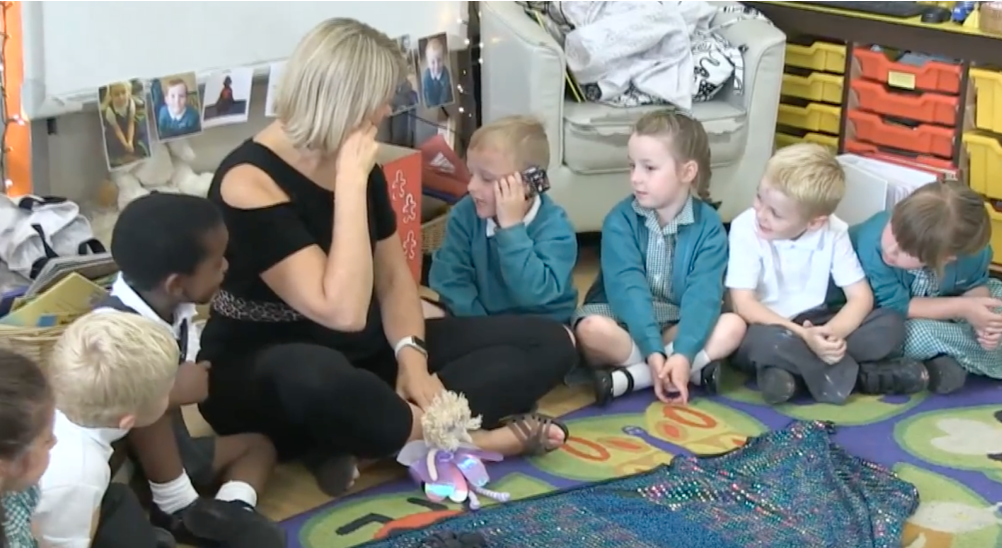
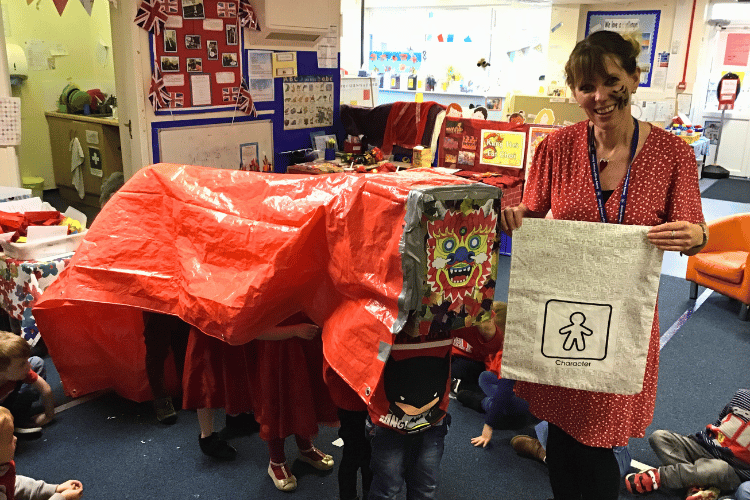
Because Tales Toolkit is a practical, hands-on, child-centred and play based approach, it provides a perfect tool. Tales Toolkit sacks contain real-life, tangible objects for storytelling and play and the props can be engaging, multi-sensory and speak to children's interests. Teachers can carefully choose to model language for a child to understand (tailored to individual needs). Through active listening and active participation, the storytelling approach allows children the opportunity to listen as well as to talk, to focus, to take turns, to share ideas and hear others. Practical storytelling can be kept short or last for a long time depending on a child’s developmental level and engagement. For children with limited attention skills, practical storytelling can be slowly extended over time to support their ability to focus for longer.
Tales Toolkit resources also encourage children to form memories and building memory makes knowledge easier to recover. Because the toolkit is practical, it is typically easier for a child to learn and develop from, than disconnected or isolated activities. It is so wonderful to see a child using Tales Toolkit resources using their existing knowledge of something and extending it.
Because Tales Toolkit stories can incorporate rhyme and song, this also supports young children’s developing ability to focus and learn through repetition. Rhyme and song also lend itself to actions and physical movement, which also help a child to cement words to memory.
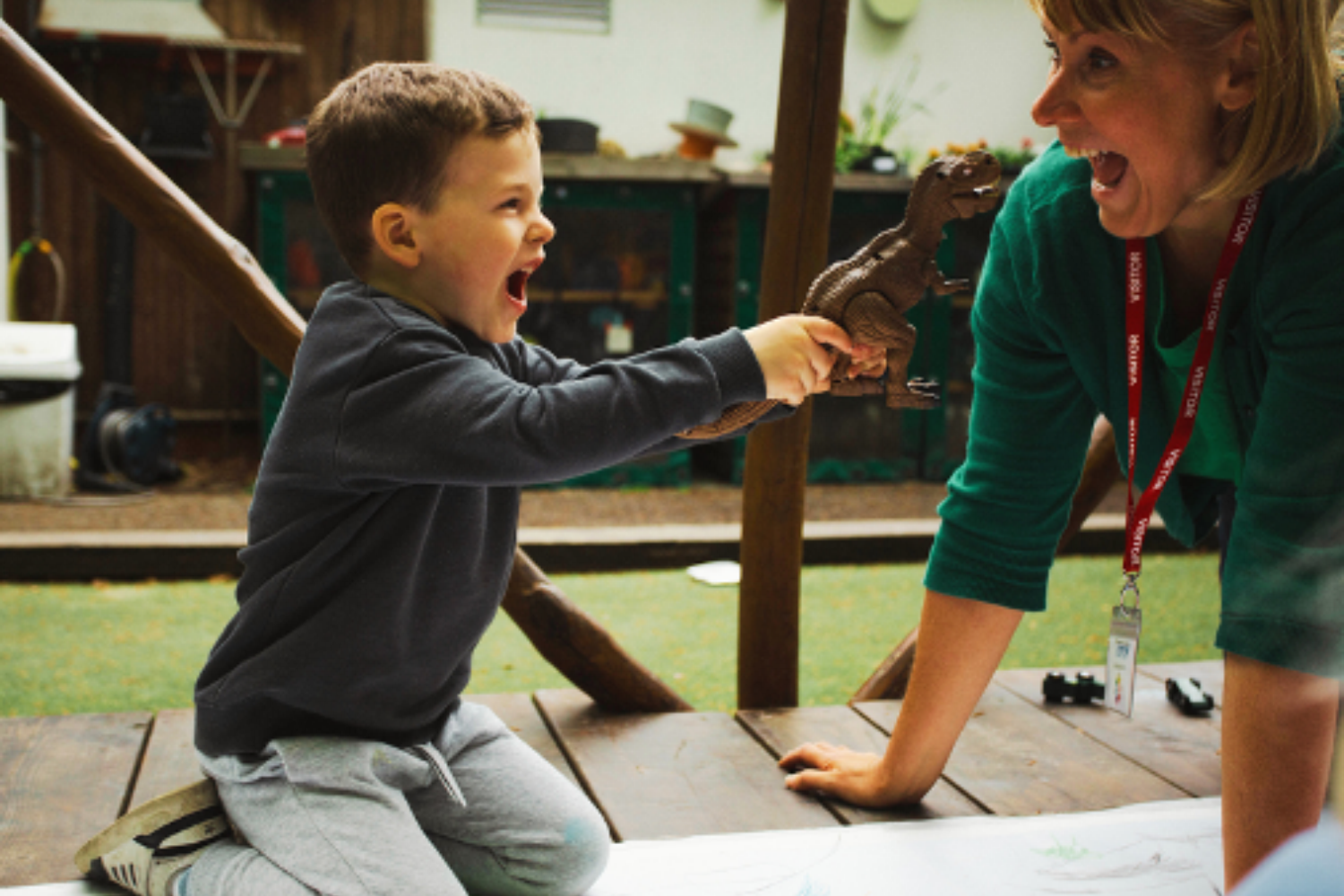
Tales Toolkit can be used to consider individual interests too. Children’s interests vary over a broad spectrum - dinosaurs, trucks, mermaids, fairies, horses, unicorns, robots, aliens, trains, the list is endless, a child is more likely to engage, if it involves something that they love! Just the same as in the adult world! As humans, we will always be drawn to what interests and motivates us! The Toolkit allows us to follow a child’s lead and share their joy.
In short, Tales Toolkit is the perfect tool to support ALL children’s attention and listening skills, regardless of developmental level.
I think what I love the most about Tales Toolkit is that it requires such little planning time and little resourcing, yet it is evidence based and shows value added without the need for lengthy, endless assessments. It doesn’t require any ‘specialist’ equipment and it doesn’t require children to be withdrawn from the classroom. It is a whole class-based, inclusive approach. Any practitioner working in a classroom will know just how important this is.
Sue Meikle (Meikle rhymes with Treacle) is an Early Years Educator with a specialism in early language development. Her work over the last 25 years has been centred around supporting young children’s language skills and in offering training for parents and other educators.
Sue is also a children’s author. She is passionate about storytelling!




.png)

.png)



.jpg)
.jpg)
.jpg)

.jpg)